

The most moving, beautiful harmony is created when extremes come together. The value of harmony lies in this unity and diversity.

The most moving, beautiful harmony is created when extremes come together. The value of harmony lies in this unity and diversity.
Sun Myung Moon

The Value of Harmony
Topic: Creativity, Culture, & the Arts
“The union of people from East and West can be compared to playing the violin: Westerners are like the low notes of a violin while Asians are like the high notes…. More excitement is created when the two extremes unite to make one harmonized picture. We do not use the word harmony to describe primarily the unity of similar things. The most moving, beautiful harmony is created when extremes come together. The value of harmony lies in this unity and diversity.”
Sun Myung Moon (born January 6, 1920, in Jeongju, in what is now North Korea – died September 3, 2012, in Gapyeong, South Korea) was a Korean religious leader, entrepreneur, and founder of the Unification movement. Raised in a rural Confucian-Christian household during the Japanese occupation of Korea, Moon’s early life was shaped by hardship, devotion, and a strong sense of spiritual calling. As a teenager, he experienced a profound vision in which he believed Jesus commissioned him to complete the work of restoring humanity to unity with God. This revelation became the foundation of his lifelong ministry, devoted to the ideal of universal peace and the healing of the relationship between the divine and human families.
In 1954, after enduring persecution and periods of imprisonment under both Japanese and communist authorities, Moon founded the Holy Spirit Association for the Unification of World Christianity in Seoul. His teachings—later presented systematically in the Exposition of the Divine Principle—offered a reinterpretation of Christian theology emphasizing God’s parental love, human responsibility, and the sanctity of marriage and family. Central to his vision was the belief that love is the creative force of the universe and that humanity’s purpose is to build a world reflecting the oneness of God’s heart. Through international missions, interfaith dialogue, and mass wedding ceremonies symbolizing global reconciliation, Moon sought to transcend divisions of race, religion, and nationality.
Beyond his religious work, Moon established numerous organizations in education, media, culture, and humanitarian service, aiming to foster dialogue, moral renewal, and peace. He and his wife, Hak Ja Han Moon, were regarded by followers as the “True Parents,” embodying the ideal of restored unity between men and women, heaven and earth. While his movement inspired both devoted commitment and significant controversy, Moon’s influence on global religion, culture, and peace initiatives remains substantial. His life reflected an unwavering pursuit of the vision of one human family under God—a vision he advanced with conviction, discipline, and enduring faith in the transformative power of divine love.
Reverend Moon's teachings went beyond the realm of the spiritual to touch on the universal human themes of love and family. He emphasized the importance of nurturing strong, loving families as the cornerstone for a harmonious and peaceful world. To this end, he conducted mass wedding ceremonies known as the 'Blessing', symbolizing the unity of all people under God, regardless of their cultural or religious backgrounds. Moon also stressed the value of community service and encouraged his followers to actively contribute to their local communities.
Sun Myung Moon's partner in both life and work was his wife, Hak Ja Han Moon. As co-leader of the Unification Church, she is a pivotal figure in spreading their shared vision of a world unified by love and peace. Affectionately known as 'True Mother', she embodies the ideal of nurturing and unconditional love in their teachings. After Reverend Moon's passing in 2012, Hak Ja Han Moon assumed sole leadership of the Unification Church and changed the name to Heavenly Parent's Holy Community. In her leadership role, she has tirelessly carried forward their mission, upholding the church's emphasis on peace, interfaith dialogue, and strong, loving families. Under her guidance, the church has continued to flourish, spreading its message of unity and love to people around the globe.
The Heart of Reunion
Eaton, David. “Can the Humanities Still Humanize?” Applied Unificationism, 21 June 2016, appliedunificationism.com/2016/06/22/can-the-humanities-still-humanize/, [Sun Myung Moon, God's Warning to the World, Book II, The Heart of Reunion] p. 151.
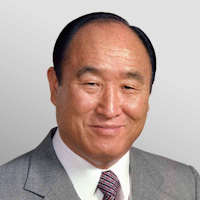
Sun Myung Moon
Resources
Copyright © 2017 – 2025 LuminaryQuotes.com About Us
Can the Humanities Still Humanize? [Excerpt]
Divine Principle instructs that the juxtaposing of Eastern and Western philosophies can provide a comprehensive ideological framework for humankind to establish a culture of peace. In his speech, God’s Warning to the World, Rev. Sun Myung Moon uses a musical analogy to demonstrate the importance of finding harmony between opposites — East and West specifically:
“The union of people from East and West can be compared to playing the violin: Westerners are like the low notes of a violin while Asians are like the high notes. Americans walk with a long, swinging stride, but the Japanese walk lightly, taking small steps. More excitement is created when the two extremes unite to make one harmonized picture. We do not use the word harmony to describe primarily the unity of similar things. The most moving, beautiful harmony is created when extremes come together. The value of harmony lies in this unity and diversity.”
Those of us who possess even a cursory understanding of the Chinese philosophical tome, the I Ching, understand that the Taoist axiom of harmonizing the polarities of Yang and Yin is one of its central tenets. The fusion of Taoist principles and Confucian ethics gives rise to rationales that guided the Chinese in matters of art and social governance. Confucianism is an “ethical-sociopolitical” philosophy that emphasized the importance of humane relationships in establishing an ideal culture. The cosmology of Yang and Yin is germane to both Confucian and Taoist doctrine and was considered elemental in humankind’s pursuit of harmony and peace.
–David Eaton [Can the Humanities Still Humanize?].
Additional Sun Myung Moon Quotes
“God’s heart of true love – to give and give more, and forget and forget again, to give unconditionally and live for the sake of others – is the foundation of the world of heart. God’s ideal out of which He created the world began from His heart. The arts, which spring from this Origin, should resemble this heart. Hence, in the world of art, there can be no barriers. Art cannot be used as propaganda or the instrument of a particular ideology. Harmony and unity are its basic principles. Divisions and conflicts are the fruits of fallen nature. Accordingly, in the world of art, East and West should understand and accept each other, through art whose character is universal and inclusive.”
–Sun Myung Moon [World Scripture II (316: 70-71, Feb. 9, 2000)] P. 169.