

Nonviolence is a lifestyle that one has to adopt, which means allowing all the love, understanding, respect, compassion, acceptance, and appreciation to emerge and dominate one’s attitude.

Nonviolence is a lifestyle that one has to adopt, which means allowing all the love, understanding, respect, compassion, acceptance, and appreciation to emerge and dominate one’s attitude.
Mohandas K. Gandhi

This Philosophy
Topic: Global Peace & Development
This philosophy is not like a jacket that you wear when necessary and discard when not. Nonviolence is a lifestyle that one has to adopt, which means allowing all the love, understanding, respect, compassion, acceptance, and appreciation to emerge and dominate one’s attitude. Then we will be able to build good relationships not only within the family but outside of the family. We will no longer be selfish and greedy but magnanimous and giving.
Mohandas Karamchand Gandhi (born October 2, 1869, in Porbandar, in the Kathiawar region of present-day Gujarat – died January 30, 1948, in New Delhi) is revered worldwide as a moral and spiritual leader whose philosophy of nonviolent resistance profoundly shaped India’s struggle for independence. Raised in a devout Hindu household, Gandhi was formed by the religious pluralism of Gujarat, where Jain, Muslim, and Hindu traditions coexisted. After studying law at the Inner Temple in London, he traveled to South Africa in 1893 to work as a legal advocate. There, his encounters with racial discrimination and the injustices faced by Indian laborers awakened his conscience and inspired his lifelong commitment to satyagraha—steadfast adherence to truth through nonviolent action.
During his two decades in South Africa, Gandhi developed the principles that would define his life: nonviolence (ahimsa), civil disobedience, and the pursuit of self-rule grounded in moral discipline. Returning to India in 1915, he became a central figure in the movement for independence from British rule. Through peaceful protests, fasting, and broad programs of social reform, he worked to reshape not only political structures but the ethical character of society. He challenged caste discrimination, campaigned against untouchability, and encouraged simplicity, self-reliance, and the use of homespun cloth (khadi) as symbols of dignity and resistance. His mass movements—such as the 1930 Salt March—became landmarks in the global history of nonviolent struggle.
Gandhi’s life embodied a living synthesis of faith and action. Drawing wisdom from the Bhagavad Gita, the Sermon on the Mount, Jain ethics, and other religious traditions, he sought unity among faiths and dignity for all people. Though he was assassinated in 1948, his legacy endures as a moral compass for those seeking justice through peace. His life continues to testify that transformation begins within—and that courage, truth, and love remain among the most powerful forces for shaping a just society.
Gandhi, Arun. “The Relevance of Gandhi Today.” Arun Gandhi - 5th Grandson of Mahatma Gandhi: Legacy of Love, 4 June 2013, arungandhi.net/the-relevance-of-gandhi-today/.
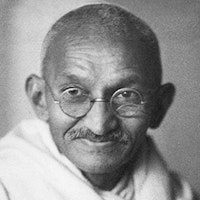
Mohandas K. Gandhi
Theme: Peace
About This Mohandas K. Gandhi Quotation [Commentary]
Mohandas K. Gandhi’s philosophy of nonviolence extends far beyond the mere absence of physical harm; it is an embracing of life principles that foster harmony and understanding. When Gandhi speaks of nonviolence as a lifestyle of “allowing all the love, understanding, respect, compassion, acceptance, and appreciation to emerge and dominate one’s attitude,” he encapsulates the essence of a life lived in profound connection with others. This philosophy, inherently intertwined with forgiveness, suggests that to forgive is not a momentary act but a sustained way of being. Through the lens of forgiveness, nonviolence becomes a dynamic process of continually embracing others’ humanity, recognizing our shared vulnerabilities, and seeking to heal rather than to harm.
The context of Gandhi’s teaching reveals that nonviolence is not a convenience but a commitment to principled living. It challenges the notion of forgiveness as a mere reactive gesture, transforming it into a proactive way of life. This life choice builds bridges between individuals, fostering good relationships that extend beyond the familial to encompass all societal interactions. In Gandhi’s vision, adopting a nonviolent approach shifts the focus from self-centeredness to a broader, magnanimous way of being that prioritizes giving over receiving. This shift is fundamental to building a community where individuals are not driven by selfishness and greed but are inspired by a sense of shared well-being and mutual respect.
Understanding Gandhi’s teachings in the context of forgiving, we find that forgiveness is an expression of the strength that lies at the heart of nonviolence. It is not about overlooking or excusing wrongs but about confronting them with a spirit that refuses to be reduced to hatred or vengeance. Gandhi’s perspective invites individuals to cultivate an inner resilience and strength that empowers them to respond to life’s challenges with a compassionate and understanding heart. This profound approach to living ensures that forgiveness is woven into the fabric of daily existence, promoting peace and understanding in a world often torn by conflict and strife.
Additional Mohandas K. Gandhi Quotes
Resources
Related Quotes
Copyright © 2017 – 2025 LuminaryQuotes.com About Us