

Truth never damages a cause that is just.

Truth never damages a cause that is just.
Mohandas K. Gandhi

A Cause That Is Just
Theme: Truth
Thomas Merton records this quote in his 1965 book Gandhi on Non-Violence, which compiles Gandhi’s teachings on nonviolence. Gandhi said this to a director of a British newspaper who wanted to publish a story sympathetic to India but failed to record the whole story of the current political turmoil. Gandhi told the man that the best way to help India would be to publish the facts unbiased, not twisting the information, because “truth never damages a cause that is just.”
Mohandas Karamchand Gandhi (born October 2, 1869, in Porbandar, in the Kathiawar region of present-day Gujarat – died January 30, 1948, in New Delhi) is revered worldwide as a moral and spiritual leader whose philosophy of nonviolent resistance profoundly shaped India’s struggle for independence. Raised in a devout Hindu household, Gandhi was formed by the religious pluralism of Gujarat, where Jain, Muslim, and Hindu traditions coexisted. After studying law at the Inner Temple in London, he traveled to South Africa in 1893 to work as a legal advocate. There, his encounters with racial discrimination and the injustices faced by Indian laborers awakened his conscience and inspired his lifelong commitment to satyagraha—steadfast adherence to truth through nonviolent action.
During his two decades in South Africa, Gandhi developed the principles that would define his life: nonviolence (ahimsa), civil disobedience, and the pursuit of self-rule grounded in moral discipline. Returning to India in 1915, he became a central figure in the movement for independence from British rule. Through peaceful protests, fasting, and broad programs of social reform, he worked to reshape not only political structures but the ethical character of society. He challenged caste discrimination, campaigned against untouchability, and encouraged simplicity, self-reliance, and the use of homespun cloth (khadi) as symbols of dignity and resistance. His mass movements—such as the 1930 Salt March—became landmarks in the global history of nonviolent struggle.
Gandhi’s life embodied a living synthesis of faith and action. Drawing wisdom from the Bhagavad Gita, the Sermon on the Mount, Jain ethics, and other religious traditions, he sought unity among faiths and dignity for all people. Though he was assassinated in 1948, his legacy endures as a moral compass for those seeking justice through peace. His life continues to testify that transformation begins within—and that courage, truth, and love remain among the most powerful forces for shaping a just society.
Gandhi, Mohandas K. "Truth never damages a cause that is just." (II - 162). Gandhi on Non-Violence: A Selection from the Writings of Mahatma Gandhi. Ed. Thomas Merton. New York: New Directions, 1965. Print.
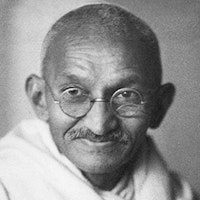
Mohandas K. Gandhi
Theme: Truth
About This Mohandas K. Gandhi Quotation [Commentary]
Mohandas K. Gandhi’s statement—“Truth never damages a cause that is just”—speaks directly to the moral strength he believed belonged to justice when it is aligned with truth. In his meeting with a British newspaper director, Gandhi challenged the man’s selective reporting on India’s political unrest. The director hoped to support India by softening the facts, but Gandhi insisted that “the best way to help India would be to publish the facts unbiased.” A just cause, he explained, does not need to be protected from the truth. In fact, any departure from truth—even for sympathetic reasons—weakens the cause itself.
For Mohandas K. Gandhi, truth was more than factual accuracy. He once wrote, “Truth is God,” and described himself as “a votary of truth from my childhood.” This spiritual view shaped his political actions. The phrase “never damages” shows his certainty: truth may reveal difficulty, but it does not harm justice. Rather, it brings clarity. Gandhi did not believe that truth must be managed or softened to protect a cause; instead, he placed full confidence in its power to support what is right without distortion.
This trust in truth also shaped his approach to non-violence. He wrote, “I claim to be a passionate seeker after truth, which is but another name for God. In the course of that search, the discovery of non-violence came to me.” For Gandhi, truth and non-violence were not separate values. Violence, in his view, misrepresents reality and creates division. Non-violence grew naturally out of his pursuit of truth. A just cause, in Gandhi’s teaching, must remain open to full and honest truth, because “truth never damages” it. If anything, it reveals the cause’s strength and brings it closer to what is divine.
“Truth never damages a cause that is just.”
Thomas Merton records this quote in his 1965 book Gandhi on Non-Violence, which compiles Gandhi’s teachings on nonviolence. Gandhi said this to a director of a British newspaper who wanted to publish a story sympathetic to India but failed to record the whole story of the current political turmoil. Gandhi told the man that the best way to help India would be to publish the facts unbiased, not twisting the information, because “truth never damages a cause that is just.”
Additional Mohandas K. Gandhi Quotations
Related Quotes
Copyright © 2017 – 2025 LuminaryQuotes.com About Us