

Faith is the starting-point of all knowledge…

Faith is the starting-point of all knowledge…
Saint Thomas Aquinas

Faith Is the Starting Point
Topic: Belief & Faith
But no one can understand unless he first believes; since faith is the starting-point of all knowledge…
Saint Thomas Aquinas (born circa 1225 in Roccasecca, Italy – died March 7, 1274, at the Abbey of Fossanova) is one of the most influential theologians and philosophers in Christian history. Born into a noble family near Naples, Thomas was educated first at the Benedictine Abbey of Monte Cassino, where his intellectual promise was recognized early. Against his family’s wishes, he later joined the Dominican Order, choosing a life of poverty, study, and preaching over the political and ecclesiastical prospects reserved for him. This decisive act of freedom and devotion marked his lifelong search for truth—a pursuit grounded in the conviction that faith and reason are harmonious paths to the same divine source.
Thomas studied under Saint Albert the Great in Cologne and Paris, where he developed a disciplined method of inquiry that sought coherence between theology and philosophy. Drawing deeply from the works of Aristotle, he reinterpreted classical thought within a Christian framework, arguing that creation’s rational order reflects the mind and goodness of God. His monumental Summa Theologica stands as a synthesis of Christian doctrine and philosophical reflection, exploring questions of existence, morality, virtue, and divine purpose. He taught that reason can guide the human mind toward understanding God’s creation, yet revelation is necessary for receiving the fullness of divine truth.
Known for his humility and serenity of mind as much as for his intellectual brilliance, Thomas approached theology as an act of worship—an offering of the intellect to God. His writings shaped the development of Western theology, ethics, natural law, and education for centuries. Canonized in 1323 and later named a Doctor of the Church, he is honored for his luminous vision of the relationship between faith and reason and for his conviction that love is the highest form of wisdom. Saint Thomas Aquinas’s legacy endures as a witness to the unity of intellect and devotion, reminding seekers that the pursuit of truth, when guided by humility and love, becomes a path toward the divine.
Aquinas later traveled to Paris to pursue further studies at the prestigious University of Paris, becoming a student of Albert the Great. As a distinguished scholar and theologian, Albert the Great imparted invaluable insights that significantly influenced Aquinas's development. After concluding his studies in Paris, Aquinas returned to Italy, imparting his knowledge as a lecturer at the University of Naples and the University of Rome. In addition to his educational pursuits, he served as an advisor to the Pope, strengthening his bond with the Church.
Throughout his career, Aquinas penned numerous works, the most notable being the Summa Theologica. This extensive treatise synthesized Christian theology and philosophy, segmented into three parts that discuss God, man, and the Christian life respectively. This work, among others, solidified Aquinas's substantial impact on Catholicism, providing defensible arguments against challenges from other religious traditions and contributing significantly to the development of Catholic doctrine. The philosophy and theology of Aquinas, known as Thomism, remains influential in contemporary Catholic thought. Predicated on the reconciliation of faith and reason, Thomism has evolved with scholars like John of St. Thomas, Francisco Suarez, and Jacques Maritain further refining its principles. Its application extends beyond theology, influencing fields such as philosophy, law, economics, and facilitating dialogue between religion and science.
Summa Theologica
Aquinas, Thomas. Summa Theologica. Translated by Fathers of the English Dominican Province. Westminster, MD: Christian Classics, 1948. P. 27. Print.
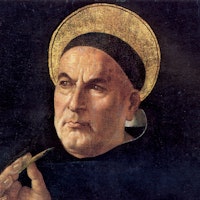
Saint Thomas Aquinas
Theme: Belief and Faith
Commentary On This Saint Thomas Aquinas Quote [Short Intro Commentary]
Aquinas’s quote “no one can understand unless he first believes; since faith is the starting-point of all knowledge” explores the relationship between belief, faith, and understanding. Aquinas argues that faith precedes understanding in the order of time, but understanding precedes faith in the order of nature. This means that we must first believe in something before we can fully understand it, but our understanding of the world must also be the foundation of our faith.
[Click on “Read More” for extended commentary]
Commentary On This Saint Thomas Aquinas Quote [Extended Commentary]
Resources
Related Quotes
Copyright © 2017 – 2025 LuminaryQuotes.com About Us