

All art is concerned with coming into being.

All art is concerned with coming into being.
Aristotle

Coming Into Being
Topic: Creativity, Culture, & the Arts
“All art is concerned with coming into being.”
Aristotle (born 384 BCE in Stagira, a city in northern Greece – died 322 BCE in Chalcis, on the island of Euboea) stands as one of the foundational figures in Western philosophy and science. Born into a family connected to medicine—his father served as court physician to the Macedonian king Amyntas III—Aristotle was immersed from an early age in observation and inquiry into the natural world. At seventeen, he traveled to Athens to study at Plato’s Academy, where he remained for nearly twenty years. While he deeply respected his teacher, Aristotle charted his own course, seeking a more empirical and systematic approach to understanding reality. His early works reflect both his gratitude for Plato’s vision and his conviction that knowledge must begin with experience.
After Plato’s death, Aristotle spent several years traveling, studying, and teaching. Around 343 BCE, he was invited by King Philip II of Macedon to tutor his son, the future Alexander the Great. When he later returned to Athens, Aristotle founded the Lyceum—also known as the Peripatetic School—a community devoted to research, teaching, and debate. There, he and his students examined every aspect of life, from logic, ethics, and politics to biology, rhetoric, and metaphysics. He classified knowledge into distinct disciplines and developed methods of reasoning that shaped scientific inquiry for millennia. His ethical writings, especially the Nicomachean Ethics, centered on the pursuit of eudaimonia: flourishing through virtue and the balanced cultivation of character.
Aristotle’s influence on philosophy, science, and education has endured for over two thousand years. His thought formed the backbone of medieval scholasticism and continues to inspire dialogue between reason, ethics, and the natural world. He saw human beings as rational and social creatures whose fulfillment lies in living thoughtfully and justly within community. For Aristotle, wisdom was not abstract speculation but a disciplined search for truth grounded in observation, dialogue, and the practice of virtue. His life and writings remain a testament to the enduring human desire to understand the world and one’s place within it.
"
Nicomachean Ethics
Wilson, Andrew, editor. World Scripture II. Universal Peace Federation, 2011, p. 163 [Aristotle, Nicomachean Ethics 6.4].
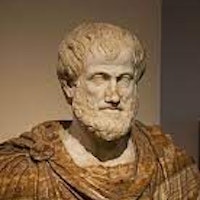
Aristotle
Copyright © 2017 – 2025 LuminaryQuotes.com About Us
Aristotle, Nicomachean Ethics 6.4