

“Curb your anger; restrain your wrath…” The way to do this is to oppose the self and, when it wants to complain about something, give thanks instead.

“Curb your anger; restrain your wrath…” The way to do this is to oppose the self and, when it wants to complain about something, give thanks instead.
Jalaluddin Mevlana Rumi

Curb Your Anger with Gratitude
Theme: Gratefulness
Jesus was asked, “O Spirit of God, what is the most tremendous and most difficult thing in this world and the next?”
“The wrath of God,” he answered.
“What can save us from it?” they asked.
“Curb your anger; restrain your wrath,” he replied.
The way to do this is to oppose the self and, when it wants to complain about something, give thanks instead. Exaggerate it so much that love is generated within you, for to give false thanks is to seek love from God.
So says our great master [Muhammad]: to complain of a creature is to complain of the Creator. He has also said that enmity and anger are hidden within you, from you, like fire. When you see a spark leap out of this fire, put it out right away, so that it may return to non-existence from whence it came. If you help it along with the match of a word of recrimination or retort, it will find a way to come again out of non-existence and only with difficulty will you be able to send it back.
Repel your enemy with something better, so that you may vanquish him: your enemy is not flesh and bone, it is his evil thought. When that is repelled from you by means of abundance of gratitude, it will be repelled from him also. This occurs naturally; as the saying goes, “The human being is a slave to beneficence.”
Jalāl al-Dīn Muḥammad Rūmī (born September 30, 1207, in Balkh, present-day Afghanistan – died December 17, 1273, in Konya, present-day Turkey) is revered as one of the world’s greatest poets, mystics, and spiritual teachers. Known in the West simply as Rumi, he was born into a family of scholars and mystics who fled westward during the Mongol invasions, eventually settling in Konya, then part of the Seljuk Empire. Under the guidance of his father, Bahāʾ al-Dīn Walad, Rumi was trained in Islamic theology, jurisprudence, and the contemplative disciplines of the Sufi path. His early years reflected the classical model of a scholar-saint—rooted in devotion, study, and service to his community.
Rumi’s life was transformed by his meeting with the wandering mystic Shams of Tabriz around 1244. Their profound spiritual companionship awakened in Rumi a passion that transcended formal learning and opened him to the depths of divine love. When Shams mysteriously disappeared, Rumi’s grief became the flame that illuminated his poetry and devotion. From this crucible emerged the Mathnawī, often called the “Persian Qur’an,” a six-volume masterpiece that weaves stories, parables, and reflections into a vision of love as the animating force of all creation. His shorter lyric poems, collected in the Divan-e Shams-e Tabrizi, sing of longing, union, loss, and the ecstatic dance between the soul and the Beloved.
Rumi’s teachings centered on the transforming power of divine love, the unity underlying all faiths, and the inward journey from self-centeredness to God-centeredness. He taught that every experience—joy and sorrow, presence and absence—serves as a mirror reflecting the divine mystery. After his passing, his followers established the Mevlevi Order, known for its sacred whirling as a form of remembrance (dhikr). Across eight centuries, Rumi’s voice has transcended language, culture, and creed, inviting seekers into the stillness of the heart where the human and divine meet in love."
Rumi's spiritual journey led him to develop a unique approach to Sufism that emphasized love, tolerance, and the pursuit of enlightenment. He created a fusion of traditional Islamic beliefs with mysticism, nurturing a school of thought that flourished in his followers. They established a sect known to the Western world as the 'Whirling Dervishes', a term derived from their mesmerizing practice of whirling as a form of physical meditation. The proper name for this branch is the Mevlevi order, dedicated to preserving and promoting Rumi's teachings.
In addition to being a mystic, Rumi was an accomplished scholar and theologian who left behind an impressive literary legacy. His best-known work, the Mathnawi or Masnavi, is a six-volume poetic epic that explores themes of love, divine mystery, and human connection to the spiritual world. Rumi's poetic style is marked by profound emotion and philosophical depth, weaving metaphors and allegory to create timeless pieces that continue to inspire readers today. Rumi's influence reaches far beyond his time, as his teachings on love, compassion, and unity continue to touch the hearts of millions, transcending barriers of religion, culture, and era.
Fihi ma Fihi
Rumi, Jalaluddin Mevlana. The Rumi Daybook. Translated by Kabir Helminski and Camille Helminski, Shambhala Publications, Inc., 2012, p. 321 [Rumi: Fihi ma Fihi: Discourse 68].
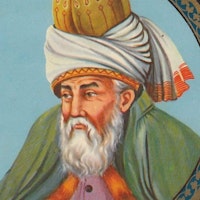
Jalaluddin Mevlana Rumi
Theme: Gratefulness
About This J. M. Rumi Quotation [Commentary]
In this quote, Rumi instructs us on the transformative power of gratitude. He suggests that by actively choosing to give thanks, especially in moments where our natural inclination may be to express anger or dissatisfaction, we align ourselves more closely with divine love. The act of giving thanks, even when it feels insincere, opens up a pathway for love to flow into our lives. Rumi contends that such an approach not only curbs our own negative emotions but also invites a deeper connection with God. It’s a simple yet profound practice that engages the heart and refines the soul.
Additional Jalaluddin Mevlana Rumi Quote: A Real Gem
A brief commentary:
In his poem “A Real Gem,” Rumi says:
I am thinking, “I may be able to become less stony and self-referential, but how on earth am I going to die to self and let go?” After communing about it, this is what I got: Practice being wholehearted and single-minded.
What happens when you wholeheartedly and single-mindedly invest yourself in an activity that you love? You enter into a state of flow, right? You “let go and let God.” You are now in Self—a state that Abraham Maslow called “self-transcendence.” In this sense, you have died to your old self.
Your new challenge is to make being in Self a spiritual practice that eventually turns this occasional state into a sustained trait. Rumi says, “When you do things from your soul, you feel a river moving in you, a joy” (Rumi, “From Your Soul”). So this “dying to self and letting go”—that your fretful ego fears—turns out to be “a joy” after all.
Resources
Related Quotes
Copyright © 2017 – 2025 LuminaryQuotes.com About Us