
• Skip to primary navigation
  • Skip to main content
  • Skip to footer
Luminary Quotes

Luminary Quotes

  • Share
  • Subscribe
  • Topics
  • Themes
  • Favorite

Search Quotes >
Share this quote

If something is true, no matter who said it, it is always from the Holy Spirit.

previous

If something is true, no matter who said it, it is always from the Holy Spirit.

Saint Thomas Aquinas

next
  • Share
  • Subscribe
  • Topics
  • Themes
  • Favorite

Search Quotes >

From the Holy Spirit

Topic: Wisdom & Understanding

If something is true, no matter who said it, it is always from the Holy Spirit.

Saint Thomas Aquinas

Saint Thomas Aquinas (born circa 1225 in Roccasecca, Italy – died March 7, 1274, at the Abbey of Fossanova) is one of the most influential theologians and philosophers in Christian history. Born into a noble family near Naples, Thomas was educated first at the Benedictine Abbey of Monte Cassino, where his intellectual promise was recognized early. Against his family’s wishes, he later joined the Dominican Order, choosing a life of poverty, study, and preaching over the political and ecclesiastical prospects reserved for him. This decisive act of freedom and devotion marked his lifelong search for truth—a pursuit grounded in the conviction that faith and reason are harmonious paths to the same divine source.
Thomas studied under Saint Albert the Great in Cologne and Paris, where he developed a disciplined method of inquiry that sought coherence between theology and philosophy. Drawing deeply from the works of Aristotle, he reinterpreted classical thought within a Christian framework, arguing that creation’s rational order reflects the mind and goodness of God. His monumental Summa Theologica stands as a synthesis of Christian doctrine and philosophical reflection, exploring questions of existence, morality, virtue, and divine purpose. He taught that reason can guide the human mind toward understanding God’s creation, yet revelation is necessary for receiving the fullness of divine truth.

Known for his humility and serenity of mind as much as for his intellectual brilliance, Thomas approached theology as an act of worship—an offering of the intellect to God. His writings shaped the development of Western theology, ethics, natural law, and education for centuries. Canonized in 1323 and later named a Doctor of the Church, he is honored for his luminous vision of the relationship between faith and reason and for his conviction that love is the highest form of wisdom. Saint Thomas Aquinas’s legacy endures as a witness to the unity of intellect and devotion, reminding seekers that the pursuit of truth, when guided by humility and love, becomes a path toward the divine.

Aquinas later traveled to Paris to pursue further studies at the prestigious University of Paris, becoming a student of Albert the Great. As a distinguished scholar and theologian, Albert the Great imparted invaluable insights that significantly influenced Aquinas's development. After concluding his studies in Paris, Aquinas returned to Italy, imparting his knowledge as a lecturer at the University of Naples and the University of Rome. In addition to his educational pursuits, he served as an advisor to the Pope, strengthening his bond with the Church.

Throughout his career, Aquinas penned numerous works, the most notable being the Summa Theologica. This extensive treatise synthesized Christian theology and philosophy, segmented into three parts that discuss God, man, and the Christian life respectively. This work, among others, solidified Aquinas's substantial impact on Catholicism, providing defensible arguments against challenges from other religious traditions and contributing significantly to the development of Catholic doctrine. The philosophy and theology of Aquinas, known as Thomism, remains influential in contemporary Catholic thought. Predicated on the reconciliation of faith and reason, Thomism has evolved with scholars like John of St. Thomas, Francisco Suarez, and Jacques Maritain further refining its principles. Its application extends beyond theology, influencing fields such as philosophy, law, economics, and facilitating dialogue between religion and science.

(ca. 1225-1274) Christianity
De Veritate

mvenner. “St. Thomas Aquinas Often Wrote, “If Something Is True, No Matter Who Said It, It Is Always from the Holy Spirit.”” CatholicNetwork.US, 31 Mar. 2018, catholicnetwork.us/2018/03/31/st-thomas-aquinas-often-wrote-if-something-is-true-no-matter-who-said-it-it-is-always-from-the-holy-spirit/. Accessed 16 Apr. 2023.
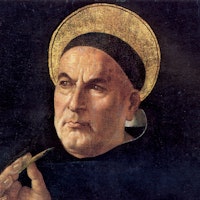
Saint Thomas Aquinas


Theme: Wisdom

Commentary On This Thomas Aquinas Quote [Brief…]

Thomas Aquinas’s declaration that all truth comes from the Holy Spirit is a profound reminder of the universal nature of wisdom. Truth is not limited to a specific person or tradition; it is a gift from God that can be found in all places and people. This understanding invites us to approach others with an open heart, seeking the shared truth that transcends our differences.

Fr. Richard Rohr Commentary [Excerpts]

“I was born 75 years ago today. I know 75 is a somewhat arbitrary number, yet our culture has assigned it some significance. CAC staff encouraged me to share my journey, and they sifted through old photo albums to illustrate my very human path. So today I offer a few reflections from my own “particular” life. I hope you, too, can see in your life your own unique manifestation of the image and likeness of God, each of us “crying what I do is me: for that I came” in Gerard Manley Hopkins’ words. …

This one Holy Spirit has moved through all of us over time—creating the Franciscans and the Second Vatican Council for Catholics, the Baptism in the Spirit for many Protestants, deep mystical movements in all faith traditions, and a growing recognition, as St. Thomas Aquinas often wrote, “If something is true, no matter who said it, it is always from the Holy Spirit.” In time, I could not help but see the many faces of Christ and the Spirit in serene Hindus, native peoples in love with the natural world, my socially conscious Jewish friends, profound Buddhist wisdom, Sufi God-lovers, and, of course, in loving Catholics, Orthodox, and Protestants of every stripe, often in spite of their denomination or theology rather than because of it.”

―St. Thomas Aquinas often wrote, “If something is true, no matter who said it, it is always from the Holy Spirit.”
BY Mvenner, March 31, 2018.

* Thomas Aquinas, De Veritate, q. 1, a. 8. The statement “Omne verum, a quocumque dicatur, a Spiritu Sancto est” was used repeatedly by Aquinas; he gave credit for it to Ambrose, an earlier Doctor of the Church.

Commentary On This Thomas Aquinas Quote [Extended…]

By recognizing the divine origin of all truth, we are called to a deeper understanding that goes beyond human bias or perspective. It’s not about being right or wrong, but about being open to the wisdom that is woven into the very fabric of existence. Aquinas teaches us that truth is not confined or owned; it is a path that leads us closer to God and one another.

Finally, Aquinas’s attribution of this thought to Ambrose reveals the timeless and interconnected nature of wisdom. It’s a humbling reminder that understanding is a shared journey, passed from one generation to another. We are all part of this ongoing exploration, invited to seek, find, and contribute to a greater collective wisdom. In doing so, we honor not just the truth in ourselves, but the divine truth that binds us all.

Fr. Billy Swan Commentary

Here I argue that the thought of St. Thomas is again required by the Church to dialogue confidently with modern science and offer three reasons why.
The Truth of Things

First, Thomas invites us to love both the natural sciences and the science of faith. Under the influence of St. Albert the Great (c. 1200-1280), Thomas appreciated the scientific study of creation as an enterprise of observation, discovery, and contemplation of all that God had made. He saw a harmony between science and faith, since, for Thomas, it is truth that unites both faith and the natural sciences. He wrote that “all truth irrespective of who expresses it, comes from the Holy Spirit” (Summa theologiae, 1-2.109.1). This means that for both the believer and the scientist, what unites them is a passion for what is true.

What also unites them is a disdain for relativism. The implications of this insight for us today is that we should not be afraid to dialogue with science—to know its power and its limits. When I worked in science, the study of physics, chemistry, and biology were not threats to my faith but routes to contemplation of all God’s handiwork, which moved me to praise him even more.

―Fr. Billy Swan, St. Thomas Aquinas and Our Dialogue with Modern Science, January 28, 2021.

Resources

  • St. Thomas Aquinas often wrote, “If something is true, no matter who said it, it is always from the Holy Spirit.” By Mvenner, March 31, 2018
  • Truth Is One Tuesday, November 22, 2016, CAC, Fr. Richard Rohr
  • God, the Holy Spirit, as Fire & Compassion BY Matthew Fox March 27, 2023 Compassion, Creation Spirituality, Holy Spirit

Related Quotes

Copyright © 2017 – 2025 LuminaryQuotes.com About Us