

The character of both nations and individuals may be defined as a pattern of consistent behavior, created on the one hand by an original ethnic, geographic and cultural endowment, and on the other hand by the vicissitudes of history, which shape and reshape, purify, corrupt and transmute this endowment.

The character of both nations and individuals may be defined as a pattern of consistent behavior, created on the one hand by an original ethnic, geographic and cultural endowment, and on the other hand by the vicissitudes of history, which shape and reshape, purify, corrupt and transmute this endowment.
Reinhold Niebuhr

A Pattern of Consistent Behavior
Topic: Justice, Vision, & Leadership
“The character of both nations and individuals may be defined as a pattern of consistent behavior, created on the one hand by an original ethnic, geographic and cultural endowment, and on the other hand by the vicissitudes of history, which shape and reshape, purify, corrupt and transmute this endowment.”
Reinhold Niebuhr (born June 21, 1892, in Wright City, Missouri – died June 1, 1971, in Stockbridge, Massachusetts) was an American theologian, ethicist, and public intellectual whose thought profoundly shaped modern Christian ethics and political philosophy. The son of German immigrant parents—his father a pastor in the Evangelical Synod—Niebuhr grew up in a household marked by faith, intellectual curiosity, and moral seriousness. After studying at Elmhurst College and Eden Theological Seminary, he completed his education at Yale Divinity School, where he began forming a theology deeply attuned to the social and ethical questions of the modern world. Ordained in 1915, he soon accepted a pastoral call in Detroit, where the stark realities of industrial labor, economic exploitation, and racial inequality began to sharpen and redirect his moral vision.
During his thirteen years in Detroit, Niebuhr confronted firsthand the tensions of industrial capitalism and the limits of individual idealism, insights that would lead to the development of his influential perspective known as Christian realism. Rejecting both sentimental optimism and rigid dogmatism, he emphasized the persistence of human sin, self-interest, and collective pride—even within movements seeking justice. His later academic career at Union Theological Seminary in New York brought him international recognition. Through seminal works such as Moral Man and Immoral Society (1932) and The Nature and Destiny of Man (1941–43), he argued that while love remains the highest moral ideal, in political life it is necessarily mediated through justice, compromise, and restraint. His writings profoundly shaped generations of theologians, philosophers, and public leaders wrestling with the complexities of democracy, power, and responsibility.
A critic of totalitarianism, nationalism, and moral complacency alike, Niebuhr defended democratic ideals while warning against prideful illusions of innocence. His famous “Serenity Prayer” reflects his practical spirituality: the courage to change what must be changed, the serenity to accept what cannot, and the wisdom to discern the difference. Though illness limited his work in his later years, he remained a moral voice calling for humility, vigilance, and compassion in a world marked by conflict and ambiguity. Niebuhr’s legacy endures as a reminder that faith must not retreat from the world’s struggles but must engage them with honesty, realism, and hope.
Niebuhr’s major works, including Moral Man and Immoral Society (1932) and The Nature and Destiny of Man (1941-1943), explored human nature’s complexities, balancing creativity with destructiveness and altruism with self-interest. His reflections on original sin and humanity’s limitations shaped his critiques of political and moral systems. He argued that justice was achievable through democracy, famously stating, “Man’s capacity for justice makes democracy possible; but man’s inclination to injustice makes democracy necessary.” His ideas deeply influenced responses to historical events like the Great Depression, World War II, and the Cold War.
Niebuhr’s influence extended beyond academia. Awarded the Presidential Medal of Freedom in 1964, he remains well-known for penning The Serenity Prayer, embraced by recovery communities and others. His reflections on the intersection of faith, politics, and human nature left a lasting impact. Niebuhr passed away on June 1, 1971, but his ideas continue to shape ethical and theological discussions today.
A Nation So Conceived
Niebuhr, Reinhold, and Alan Heimert. A Nation so Conceived: Reflections on the History of America from Its Early Visions to Its Present Power. Greenwood Press, 1983, p. 7 [Reinhold Niebuhr and Alain Heimert. A Nation So Conceived].
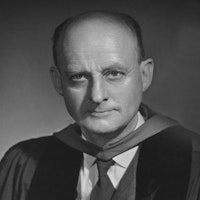
Reinhold Niebuhr
Copyright © 2017 – 2025 LuminaryQuotes.com About Us
Commentary by Martin E. Marty
Niebuhr could mourn the failure of good ideas in America. He was constantly critical of the way Puritans in practice corrupted their idea of taking “prosperity and adversity in its stride [into] a religion which became preoccupied with the prosperity of the new community.” In doing so they came to see Jefferson’s”‘Useful knowledge’ as the only valuable knowledge,” it was “Knowledge ‘applied to common purposes of life.'”
[The Irony of American History, New York, 1952, p.49]
–Reinhold Niebuhr [Public Theology and the American Experience, Martin E. Marty in the Journal of Religion, 1974]
Additional Reinhold Niebuhr Quotes
“We are always part of the drama of life which we behold; and the emotions of the drama therefore color our beholding.”
–Reinhold Niebuhr, Discerning the Signs of the Times, 1946, p. 10