

To call woman the weaker sex is a libel; it is man’s injustice to woman…. If nonviolence is the law of our being, the future is with woman.

To call woman the weaker sex is a libel; it is man’s injustice to woman…. If nonviolence is the law of our being, the future is with woman.
Mohandas K. Gandhi

The Future Is with Women
Topic: Justice, Vision, & Leadership
“To call woman the weaker sex is a libel; it is man’s injustice to woman. If by strength is meant brute strength, then, indeed, is woman less brute than man. If by strength is meant moral power, then woman is immeasurably man’s superior. Has she not greater intuition, is she not more self-sacrificing, has she not greater powers of endurance, has she not greater courage? Without her, man could not be. If nonviolence is the law of our being, the future is with woman. Who can make a more effective appeal to the heart than woman?”
Mohandas Karamchand Gandhi (born October 2, 1869, in Porbandar, in the Kathiawar region of present-day Gujarat – died January 30, 1948, in New Delhi) is revered worldwide as a moral and spiritual leader whose philosophy of nonviolent resistance profoundly shaped India’s struggle for independence. Raised in a devout Hindu household, Gandhi was formed by the religious pluralism of Gujarat, where Jain, Muslim, and Hindu traditions coexisted. After studying law at the Inner Temple in London, he traveled to South Africa in 1893 to work as a legal advocate. There, his encounters with racial discrimination and the injustices faced by Indian laborers awakened his conscience and inspired his lifelong commitment to satyagraha—steadfast adherence to truth through nonviolent action.
During his two decades in South Africa, Gandhi developed the principles that would define his life: nonviolence (ahimsa), civil disobedience, and the pursuit of self-rule grounded in moral discipline. Returning to India in 1915, he became a central figure in the movement for independence from British rule. Through peaceful protests, fasting, and broad programs of social reform, he worked to reshape not only political structures but the ethical character of society. He challenged caste discrimination, campaigned against untouchability, and encouraged simplicity, self-reliance, and the use of homespun cloth (khadi) as symbols of dignity and resistance. His mass movements—such as the 1930 Salt March—became landmarks in the global history of nonviolent struggle.
Gandhi’s life embodied a living synthesis of faith and action. Drawing wisdom from the Bhagavad Gita, the Sermon on the Mount, Jain ethics, and other religious traditions, he sought unity among faiths and dignity for all people. Though he was assassinated in 1948, his legacy endures as a moral compass for those seeking justice through peace. His life continues to testify that transformation begins within—and that courage, truth, and love remain among the most powerful forces for shaping a just society.
Young India
Gandhi, Mohandas K. “Mahatma Gandhi.” Wikiquote, en.wikiquote.org/wiki/Mahatma_Gandhi, [Mohandas K. Gandhi, "Young India," 1930].
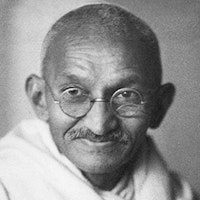
Mohandas K. Gandhi
Copyright © 2017 – 2025 LuminaryQuotes.com About Us
Mohandas K. Gandhi
Mohandas Karamchand Gandhi (2 October 1869 – 30 January 1948), commonly known as Mahatma Gandhi (In Sanskrit mahātmā means “Great Soul”).
Additional Mohandas K. Gandhi Quotes
“I am uncompromising in the matter of woman’s rights. In my opinion she should labor under no legal disability not suffered by man, I should treat the daughters and sons on a footing of perfect equality.”
–Mohandas Gandhi, 17th October 1929 [Quoted in Gandhi: The Essential Writings, Judith M. Brown, Oxford University Press, 1998] pp. 228-9.
“To see the universal and all-pervading Spirit of Truth face to face one must be able to love the meanest of creation as oneself. And a man who aspires after that cannot afford to keep out of any field of life. That is why my devotion to Truth has drawn me into the field of politics; and I can say without the slightest hesitation, and yet in all humility, that those who say that religion has nothing to do with politics do not know what religion means.
Identification with everything that lives is impossible without self-purification; without self-purification the observance of the law of Ahimsa must remain an empty dream; God can never be realized by one who is not pure of heart. Self-purification therefore must mean purification in all the walks of life. And purification being highly infectious, purification of oneself necessarily leads to the purification of one’s surroundings.
But the path of self-purification is hard and steep. To attain to perfect purity one has to become absolutely passion-free in thought, speech and action; to rise above the opposing currents of love and hatred, attachment and repulsion. I know that I have not in me as yet that triple purity, in spite of constant ceaseless striving for it. That is why the world’s praise fails to move me, indeed it very often stings me. To conquer the subtle passions seems to me to be far harder than the physical conquest of the world by the force of arms. Ever since my return to India I have had experiences of the dormant passions lying hidden within me. The knowledge of them has made me feel humiliated though not defeated. The experiences and experiments have sustained me and given me great joy. But I know that I have still before me a difficult path to traverse. I must reduce myself to zero. So long as a man does not of his own free will put himself last among his fellow creatures, there is no salvation for him. Ahimsa is the farthest limit of humility.”
–Mohandas K. Gandhi [Farewell] p. 454.