

Those who discovered for us the Law of Love were greater scientists than any of our modern scientists.

Those who discovered for us the Law of Love were greater scientists than any of our modern scientists.
Mohandas K. Gandhi

The Law of Love
Theme: Love
Those who discovered for us the Law of Love were greater scientists than any of our modern scientists. Only our explorations have not gone far enough, and so it is not possible for everyone to see all of its workings… Whether mankind will consciously follow the Law of Love, I do not know. But that need not perturb us. The Law will work, just as the law of Gravitation will work.
Mohandas Karamchand Gandhi (born October 2, 1869, in Porbandar, in the Kathiawar region of present-day Gujarat – died January 30, 1948, in New Delhi) is revered worldwide as a moral and spiritual leader whose philosophy of nonviolent resistance profoundly shaped India’s struggle for independence. Raised in a devout Hindu household, Gandhi was formed by the religious pluralism of Gujarat, where Jain, Muslim, and Hindu traditions coexisted. After studying law at the Inner Temple in London, he traveled to South Africa in 1893 to work as a legal advocate. There, his encounters with racial discrimination and the injustices faced by Indian laborers awakened his conscience and inspired his lifelong commitment to satyagraha—steadfast adherence to truth through nonviolent action.
During his two decades in South Africa, Gandhi developed the principles that would define his life: nonviolence (ahimsa), civil disobedience, and the pursuit of self-rule grounded in moral discipline. Returning to India in 1915, he became a central figure in the movement for independence from British rule. Through peaceful protests, fasting, and broad programs of social reform, he worked to reshape not only political structures but the ethical character of society. He challenged caste discrimination, campaigned against untouchability, and encouraged simplicity, self-reliance, and the use of homespun cloth (khadi) as symbols of dignity and resistance. His mass movements—such as the 1930 Salt March—became landmarks in the global history of nonviolent struggle.
Gandhi’s life embodied a living synthesis of faith and action. Drawing wisdom from the Bhagavad Gita, the Sermon on the Mount, Jain ethics, and other religious traditions, he sought unity among faiths and dignity for all people. Though he was assassinated in 1948, his legacy endures as a moral compass for those seeking justice through peace. His life continues to testify that transformation begins within—and that courage, truth, and love remain among the most powerful forces for shaping a just society.
Gandhi, Mahatma. "Non-Violence in Peace and War." Navajivan Publishing House, 1942.
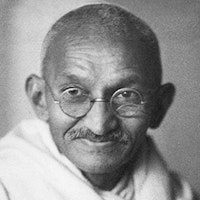
Mohandas K. Gandhi
Theme: Love
About This Mohandas K. Gandhi Quotation [Commentary]
Mohandas K. Gandhi’s statement, “Those who discovered for us the Law of Love were greater scientists than any of our modern scientists,” elevates the understanding of love and nonviolence to the level of scientific discovery. Gandhi believed that the principles of love and nonviolence were as universal and powerful as the laws of physics. By comparing these moral laws to scientific laws, Gandhi highlights the idea that love and nonviolence have the potential to transform society significantly. This comparison suggests that the exploration and application of love require a systematic and dedicated approach, similar to scientific inquiry.
The context passage further explains Gandhi’s vision, suggesting that humanity’s exploration of the Law of Love is still in its early stages. Gandhi implies that just as scientific laws operate regardless of human belief, the Law of Love will function regardless of whether humanity consciously adheres to it. This reflects Gandhi’s faith in the intrinsic power of love and nonviolence to work independently of human acknowledgment. His reference to the law of gravitation reinforces the idea that certain truths and forces are constant, existing regardless of our awareness or acceptance.
In the context of love, Gandhi’s quote emphasizes that true understanding and practice of love can lead to significant change. Gandhi’s view that those who understand and apply the Law of Love are greater than traditional scientists suggests that individuals who embody and practice these principles possess unique wisdom and capability to enact positive change. This highlights the importance of love as a guiding force, aligning with Gandhi’s lifelong commitment to nonviolence and social justice. By recognizing love as a powerful and transformative force, Gandhi’s message encourages deeper exploration and dedication to its principles.
Mohandas K. Gandhi, The Law of Love [Commentary]
Mohandas K. Gandhi often spoke about the “Law of Love” as a fundamental principle governing human interactions and society. In his view, this law was as immutable and powerful as the physical laws that govern the natural world. Here’s an explanation based on Gandhi’s words and teachings:
In summary, Gandhi’s Law of Love is a principle that emphasizes the power of love and nonviolence as universal, transformative forces. It calls for a moral commitment to compassion and service, and it recognizes the systematic and deliberate practice of love as essential for creating a just and harmonious society.
Resources
Related Quotes
Copyright © 2017 – 2025 LuminaryQuotes.com About Us