

When Heaven creates a thing, it gives each thing a principle of truth.

When Heaven creates a thing, it gives each thing a principle of truth.
Zhu Xi

A Principle of Truth
Topic: Truth, Law, & Principle
When Heaven creates a thing, it gives each thing a principle of truth.
Zhu Xi (born October 18, 1130, in Youxi, Fujian Province, China – died April 23, 1200, in Chunan, Zhejiang Province, China) was one of the most influential philosophers, teachers, and scholars of the Song dynasty. A leading figure in Neo-Confucianism, Zhu Xi sought to renew and deepen the moral and metaphysical teachings of Confucius and Mencius, integrating them with Buddhist and Daoist insights into a unified vision of human nature and the cosmos. His early education was guided by his father and local scholars, and by his teenage years, Zhu Xi had already gained a reputation for intellectual rigor and moral seriousness. He passed the highest level of the imperial examinations at age nineteen, marking the beginning of a life devoted to scholarship and service.
Throughout his career, Zhu Xi combined official responsibilities with an enduring commitment to teaching and contemplation. He established academies where students engaged not only in study but in moral cultivation and community life. His reinterpretation of the Four Books—the Analects, Mencius, Great Learning, and Doctrine of the Mean—became the foundation for civil service education in China for centuries. Zhu Xi emphasized li (principle) as the underlying order of the universe and qi (vital energy) as its material expression, teaching that true wisdom comes through quiet reflection and disciplined self-cultivation. His method of “investigating things” (gewu) invited students to seek harmony between inner clarity and the natural world.
Zhu Xi’s influence extended far beyond his lifetime. Though his ideas were initially contested, his commentaries eventually shaped the moral and intellectual life of East Asia, profoundly influencing Korean, Japanese, and Vietnamese traditions as well. He is remembered not only as a philosopher but as a moral exemplar—humble in spirit, devoted to learning, and grounded in the conviction that truth must be lived, not merely known. Zhu Xi’s vision of harmony between principle and practice continues to inspire reflection on how human beings may cultivate virtue and align with the deeper order of the universe.
In "Further Reflection on Things at Hand," Zhu Xi emphasized the importance of proper conduct and constant self-cultivation. He urged his followers to diligently adhere to moral norms, practicing them day and night until they become internalized. The idea was to attain a state of moral behavior and thought that was so ingrained it didn't require conscious effort. This approach to moral cultivation reflected Zhu Xi's broader philosophical framework, which saw the understanding and realization of moral principles as the path to achieving harmony with the natural order of the universe.
Zhu Xi's philosophy has had a profound and lasting impact on Confucian thought and Chinese intellectual history. His interpretation of Confucianism became the state orthodoxy in China for several centuries. His works, such as "Commentaries on the Four Books," were used as standard texts for civil service examinations in China until the early 20th century. Today, Zhu Xi is recognized as one of the greatest scholars in Chinese history, and his teachings continue to inspire and inform Confucian thought.
Wilson, Andrew, editor. World Scripture II. Universal Peace Federation, 2011, p. 57 [Chu Hsi]
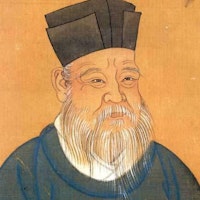
Zhu Xi
Copyright © 2017 – 2025 LuminaryQuotes.com About Us