

The virtues we acquire by first having actually practiced them, just as we do the arts.

The virtues we acquire by first having actually practiced them, just as we do the arts.
Aristotle

The Virtues Spiritual Practice
Theme: Spiritual Growth
The virtues we acquire by first having actually practiced them, just as we do the arts. We learn an art or craft by doing the things that we shall have to do when we have learnt it: for instance, men become builders by building houses, harpists by playing on the harp. Similarly we become just by doing just acts, temperate by doing temperate acts, brave by doing brave acts.
Aristotle (born 384 BCE in Stagira, a city in northern Greece – died 322 BCE in Chalcis, on the island of Euboea) stands as one of the foundational figures in Western philosophy and science. Born into a family connected to medicine—his father served as court physician to the Macedonian king Amyntas III—Aristotle was immersed from an early age in observation and inquiry into the natural world. At seventeen, he traveled to Athens to study at Plato’s Academy, where he remained for nearly twenty years. While he deeply respected his teacher, Aristotle charted his own course, seeking a more empirical and systematic approach to understanding reality. His early works reflect both his gratitude for Plato’s vision and his conviction that knowledge must begin with experience.
After Plato’s death, Aristotle spent several years traveling, studying, and teaching. Around 343 BCE, he was invited by King Philip II of Macedon to tutor his son, the future Alexander the Great. When he later returned to Athens, Aristotle founded the Lyceum—also known as the Peripatetic School—a community devoted to research, teaching, and debate. There, he and his students examined every aspect of life, from logic, ethics, and politics to biology, rhetoric, and metaphysics. He classified knowledge into distinct disciplines and developed methods of reasoning that shaped scientific inquiry for millennia. His ethical writings, especially the Nicomachean Ethics, centered on the pursuit of eudaimonia: flourishing through virtue and the balanced cultivation of character.
Aristotle’s influence on philosophy, science, and education has endured for over two thousand years. His thought formed the backbone of medieval scholasticism and continues to inspire dialogue between reason, ethics, and the natural world. He saw human beings as rational and social creatures whose fulfillment lies in living thoughtfully and justly within community. For Aristotle, wisdom was not abstract speculation but a disciplined search for truth grounded in observation, dialogue, and the practice of virtue. His life and writings remain a testament to the enduring human desire to understand the world and one’s place within it.
"
Nicomachean Ethics
Wilson, Andrew, editor. World Scripture II. Universal Peace Federation, 2011, p. 569 [Aristotle, Nichomachean Ethics 2.1.4.].
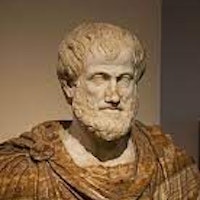
Aristotle
Theme: Spiritual Growth
Aristotle, Nichomachean Ethics 2.1.4
This passage from Aristotle’s Nicomachean Ethics (Book II, Chapter 1, Section 4) is a foundational statement in his ethical theory. Aristotle is arguing that virtues are habits that we develop through repeated actions. This is a crucial aspect of his virtue ethics, which emphasizes the cultivation of good character traits (virtues) as the key to ethical behavior.
Let’s examine this passage more closely:
“The virtues we acquire by first having actually practiced them, just as we do the arts.”
Here, Aristotle draws an analogy between learning an art or craft and developing a virtue. Just as we become proficient in an art by practicing it, we become virtuous by practicing virtuous actions. This means that virtue is not something innate or given to us; it is something we must actively work on and cultivate. This statement also implies that anyone can become virtuous, as long as they are willing to practice and learn, just as anyone can learn a new art or craft.
“We learn an art or craft by doing the things that we shall have to do when we have learnt it: for instance, men become builders by building houses, harpists by playing on the harp.”
Here, Aristotle emphasizes his point by providing specific examples. A person becomes a builder by actually building, not merely by studying or contemplating building. Similarly, a person becomes a harpist by playing the harp, not just by learning about it. Aristotle is emphasizing the importance of practical engagement and experience in learning and self-development.
“Similarly we become just by doing just acts, temperate by doing temperate acts, brave by doing brave acts.”
In the final sentence, Aristotle applies the principle he’s established to moral virtues. Just as a builder becomes a builder by building, a person becomes just by doing just acts, temperate by doing temperate acts, and brave by doing brave acts. This suggests that our moral character is shaped by our actions. If we want to be virtuous, we must act virtuously.
This view is somewhat counterintuitive, as we often think of our actions as reflecting our character, rather than forming it. But for Aristotle, the relationship between action and character is reciprocal: our actions form our character, and our character in turn guides our future actions. This also implies a responsibility for our own moral development: if we want to be good, we must make a conscious effort to do good deeds.
In summary, this passage from the Nicomachean Ethics underlines the importance of practice and active engagement in the development of virtues according to Aristotle’s ethical theory. Virtues are not innate or given; they are developed and cultivated through our actions. This perspective places a significant emphasis on individual responsibility for moral development and the formative role of our actions in shaping our character.
Related Quotes
Copyright © 2017 – 2025 LuminaryQuotes.com About Us