

When you do things from your soul, you feel a river moving in you, a joy.

When you do things from your soul, you feel a river moving in you, a joy.
Jalaluddin Mevlana Rumi

From Your Soul
Topic: Immanence & Transcendence
When you do things from your soul,
you feel a river moving in you, a joy.
When actions come from another section,
the feeling disappears.Don’t let others lead you. They may be blind,
or worse, vultures. Reach for the rope
of God. And what is that?Putting aside self-will.
Because of willfulness people sit in jail.
From willfulness, the trapped birds’ wings are tied.
From willfulness, the fish sizzles in the skillet.
The anger of police is willfulness.
You’ve seen a magistrate inflict visible punishment.
Now see the invisible.If you could leave selfishness, you would see
how your soul has been tortured.
We are born and live inside black water in a well.
How could we know what an open field of sunlight is?Don’t insist on going where you think you want to go.
Ask the way to the Spring.
Your living pieces will form a harmony.There is a moving palace that floats through the air,
with balconies and clear water running in every part of it,
infinity everywhere, yet contained under a single tent.
Jalāl al-Dīn Muḥammad Rūmī (born September 30, 1207, in Balkh, present-day Afghanistan – died December 17, 1273, in Konya, present-day Turkey) is revered as one of the world’s greatest poets, mystics, and spiritual teachers. Known in the West simply as Rumi, he was born into a family of scholars and mystics who fled westward during the Mongol invasions, eventually settling in Konya, then part of the Seljuk Empire. Under the guidance of his father, Bahāʾ al-Dīn Walad, Rumi was trained in Islamic theology, jurisprudence, and the contemplative disciplines of the Sufi path. His early years reflected the classical model of a scholar-saint—rooted in devotion, study, and service to his community.
Rumi’s life was transformed by his meeting with the wandering mystic Shams of Tabriz around 1244. Their profound spiritual companionship awakened in Rumi a passion that transcended formal learning and opened him to the depths of divine love. When Shams mysteriously disappeared, Rumi’s grief became the flame that illuminated his poetry and devotion. From this crucible emerged the Mathnawī, often called the “Persian Qur’an,” a six-volume masterpiece that weaves stories, parables, and reflections into a vision of love as the animating force of all creation. His shorter lyric poems, collected in the Divan-e Shams-e Tabrizi, sing of longing, union, loss, and the ecstatic dance between the soul and the Beloved.
Rumi’s teachings centered on the transforming power of divine love, the unity underlying all faiths, and the inward journey from self-centeredness to God-centeredness. He taught that every experience—joy and sorrow, presence and absence—serves as a mirror reflecting the divine mystery. After his passing, his followers established the Mevlevi Order, known for its sacred whirling as a form of remembrance (dhikr). Across eight centuries, Rumi’s voice has transcended language, culture, and creed, inviting seekers into the stillness of the heart where the human and divine meet in love."
Rumi's spiritual journey led him to develop a unique approach to Sufism that emphasized love, tolerance, and the pursuit of enlightenment. He created a fusion of traditional Islamic beliefs with mysticism, nurturing a school of thought that flourished in his followers. They established a sect known to the Western world as the 'Whirling Dervishes', a term derived from their mesmerizing practice of whirling as a form of physical meditation. The proper name for this branch is the Mevlevi order, dedicated to preserving and promoting Rumi's teachings.
In addition to being a mystic, Rumi was an accomplished scholar and theologian who left behind an impressive literary legacy. His best-known work, the Mathnawi or Masnavi, is a six-volume poetic epic that explores themes of love, divine mystery, and human connection to the spiritual world. Rumi's poetic style is marked by profound emotion and philosophical depth, weaving metaphors and allegory to create timeless pieces that continue to inspire readers today. Rumi's influence reaches far beyond his time, as his teachings on love, compassion, and unity continue to touch the hearts of millions, transcending barriers of religion, culture, and era.
Rūmī Jalāl al-Dīn. The Essential Rumi. Interpreted by Coleman Barks, HarperCollins, 2004 [Moving Water by J. M. Rumi].
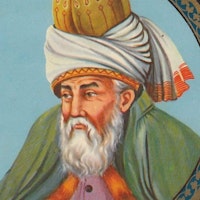
Jalaluddin Mevlana Rumi
Theme: Our Soul
About This Rumi Quotation [Commentary]
Jalaluddin Mevlana Rumi’s line, “When you do things from your soul, you feel a river moving in you, a joy,” begins with a quiet but unmistakable clarity. He describes joy not as a fleeting sensation, but as a current within—felt when actions come from the soul’s depth. The river moves naturally, without force or resistance. In contrast, “when actions come from another section, the feeling disappears.” What’s at stake is not only the quality of feeling, but the presence or absence of something vital—the soul’s quiet movement within.
The surrounding lines deepen this contrast. “Don’t let others lead you,” Rumi warns. “They may be blind, or worse, vultures.” To follow external voices or inner impulses shaped by fear or control is to fall into what he calls “willfulness.” This self-centered drive is not just unwise—it harms. “From willfulness, the trapped birds’ wings are tied. From willfulness, the fish sizzles in the skillet.” These images speak of confinement and suffering. His alternative is not passivity but a different kind of strength: “Reach for the rope of God. And what is that? Putting aside self-will.”
Rumi continues with a stark picture of spiritual disconnection: “We are born and live inside black water in a well.” This is a condition of unawareness, not punishment. Yet the possibility of awakening remains. “Ask the way to the Spring,” he writes. It is a return to source. When the self is set aside, “your living pieces will form a harmony.” The final vision—“a moving palace… with balconies and clear water running in every part of it”—points to what becomes available when the soul leads. This is not abstraction. “Infinity everywhere, yet contained under a single tent.” The soul does not need to strive. It needs to be remembered.
About This Coleman Barks Interpretation
Coleman Barks’s rendering of this passage is not a direct translation from the original Persian, but a poetic interpretation based on the scholarly English translations of A. J. Arberry and Reynold A. Nicholson. While he does not work from Rumi’s language directly, Barks brings a unique sensibility to the text—prioritizing rhythm, accessibility, and spiritual resonance. His work has introduced millions to the beauty of Rumi’s voice and has opened a pathway to the deeper themes of the soul, longing, and inner transformation. At the same time, Barks’s approach omits many essential elements of Rumi’s original context, including frequent references to the Qur’an, the Prophet Muhammad, and the Sufi path. These omissions matter, especially for those seeking to understand Rumi’s teachings in their full spiritual and cultural framework. His interpretations are deeply felt and artfully rendered, but they are best read alongside direct scholarly translations grounded in the Persian, such as those by Nicholson, Arberry, Jawid Mojaddedi, or Ibrahim Gamard.
To Clarify Rumi’s name
Jalal al-Din Muhammad Rumi, also known as Jalaluddin Mevlana Rumi, has multiple variations of his name due to his diverse cultural and linguistic background. “Jalal al-Din” is his given name, meaning “Glory of the Faith” in Arabic. “Muhammad” is his first name. “Rumi” is a nickname meaning “from Rum” or “Roman,” referring to his time spent in the Seljuk Sultanate of Rum in Anatolia, which was formerly part of the Byzantine (Eastern Roman) Empire. “Mevlana” or “Mawlana” is an honorific title meaning “our master” in Arabic, reflecting his status as a respected spiritual teacher. These various elements of his name are combined differently in different contexts, with some emphasizing his given name and others focusing on his honorific titles and geographical associations.
Resources
Related Quotes
Copyright © 2017 – 2025 LuminaryQuotes.com About Us