

When you do things from your soul, you feel a river moving in you, a joy.

When you do things from your soul, you feel a river moving in you, a joy.
Jalaluddin Mevlana Rumi

A Joy
Topic: Joy & Happiness
When you do things from your soul,
you feel a river moving in you, a joy.
When actions come from another section,
the feeling disappears.
Don’t let others lead you. They may be blind,
or worse, vultures. Reach for the rope
of God. And what is that?
Putting aside self-will.
Because of willfulness people sit in jail.
From willfulness, the trapped birds’ wings are tied.
From willfulness, the fish sizzles in the skillet.
The anger of police is willfulness.
You’ve seen a magistrate inflict visible punishment.
Now see the invisible.
If you could leave selfishness, you would see
how your soul has been tortured.
We are born and live inside black water in a well.
How could we know what an open field of sunlight is?
Don’t insist on going where you think you want to go.
Ask the way to the Spring.
Your living pieces will form a harmony.
There is a moving palace that floats through the air,
with balconies and clear water running in every part of it,
infinity everywhere, yet contained under a single tent.
Jalāl al-Dīn Muḥammad Rūmī (born September 30, 1207, in Balkh, present-day Afghanistan – died December 17, 1273, in Konya, present-day Turkey) is revered as one of the world’s greatest poets, mystics, and spiritual teachers. Known in the West simply as Rumi, he was born into a family of scholars and mystics who fled westward during the Mongol invasions, eventually settling in Konya, then part of the Seljuk Empire. Under the guidance of his father, Bahāʾ al-Dīn Walad, Rumi was trained in Islamic theology, jurisprudence, and the contemplative disciplines of the Sufi path. His early years reflected the classical model of a scholar-saint—rooted in devotion, study, and service to his community.
Rumi’s life was transformed by his meeting with the wandering mystic Shams of Tabriz around 1244. Their profound spiritual companionship awakened in Rumi a passion that transcended formal learning and opened him to the depths of divine love. When Shams mysteriously disappeared, Rumi’s grief became the flame that illuminated his poetry and devotion. From this crucible emerged the Mathnawī, often called the “Persian Qur’an,” a six-volume masterpiece that weaves stories, parables, and reflections into a vision of love as the animating force of all creation. His shorter lyric poems, collected in the Divan-e Shams-e Tabrizi, sing of longing, union, loss, and the ecstatic dance between the soul and the Beloved.
Rumi’s teachings centered on the transforming power of divine love, the unity underlying all faiths, and the inward journey from self-centeredness to God-centeredness. He taught that every experience—joy and sorrow, presence and absence—serves as a mirror reflecting the divine mystery. After his passing, his followers established the Mevlevi Order, known for its sacred whirling as a form of remembrance (dhikr). Across eight centuries, Rumi’s voice has transcended language, culture, and creed, inviting seekers into the stillness of the heart where the human and divine meet in love."
Rumi's spiritual journey led him to develop a unique approach to Sufism that emphasized love, tolerance, and the pursuit of enlightenment. He created a fusion of traditional Islamic beliefs with mysticism, nurturing a school of thought that flourished in his followers. They established a sect known to the Western world as the 'Whirling Dervishes', a term derived from their mesmerizing practice of whirling as a form of physical meditation. The proper name for this branch is the Mevlevi order, dedicated to preserving and promoting Rumi's teachings.
In addition to being a mystic, Rumi was an accomplished scholar and theologian who left behind an impressive literary legacy. His best-known work, the Mathnawi or Masnavi, is a six-volume poetic epic that explores themes of love, divine mystery, and human connection to the spiritual world. Rumi's poetic style is marked by profound emotion and philosophical depth, weaving metaphors and allegory to create timeless pieces that continue to inspire readers today. Rumi's influence reaches far beyond his time, as his teachings on love, compassion, and unity continue to touch the hearts of millions, transcending barriers of religion, culture, and era.
Rūmī Jalāl al-Dīn. The Essential Rumi. Translated by Coleman Barks, HarperCollins, 2004 [Moving Water by J. M. Rumi].
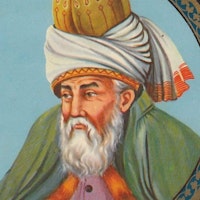
Jalaluddin Mevlana Rumi
Theme: Joy
About This Jalaluddin Mevlana Rumi Quote [Commentary]
Jalaluddin Mevlana Rumi, a 13th-century Persian poet and Sufi mystic, teaches that joy comes not from external achievements but from aligning our actions with the soul’s essence. His metaphor, “When you do things from your soul, you feel a river moving in you, a joy,” captures the essence of true contentment found in living authentically. This joy, like a flowing river, symbolizes a state of grace and ease achieved by engaging with life from a place of deep authenticity. Rumi’s words suggest that genuine happiness is found in the harmony between one’s actions and innermost being, emphasizing that true contentment and vitality spring from within.
Rumi warns against the pitfalls of willfulness, differentiating between pursuing goals that resonate with one’s higher purpose and stubbornly following self-centered desires. He advocates for surrendering not to defeat but to the wisdom of the soul, which naturally inclines towards goodness and love. This act of surrender is portrayed not as giving up but as aligning with universal love and harmony, offering a pathway to freedom and joy beyond the ego’s temporary pleasures. Rumi’s counsel is a reminder that true joy and fulfillment lie in embracing the soul’s guidance over ego-driven ambitions.
Rumi’s teachings invite us to find joy in the ordinary and the divine within the mundane. He encourages seeking the “Spring”—a metaphor for the eternal source of joy within us, independent of external conditions. This intrinsic joy is accessible through living in alignment with our soul’s desires, offering a perspective where joy is not an external goal but an ever-present companion. Rumi’s poetic wisdom guides us toward recognizing and embracing the inner wellspring of joy, suggesting a journey filled with ease, grace, and the discovery of our deepest connections.
Love Makes All the Difference: An Introduction to Rumi, by Jason Espada
Resources
Related Quotes
Copyright © 2017 – 2025 LuminaryQuotes.com About Us