

For I can see that in the midst of death life persists, in the midst of untruth truth persists, in the midst of darkness light persists…

For I can see that in the midst of death life persists, in the midst of untruth truth persists, in the midst of darkness light persists…
Mohandas K. Gandhi

In the Midst of Darkness
Topic: Divine Love & Goodness
I do dimly perceive that whilst everything around me is ever changing, ever dying, there is underlying all that change a living power that is changeless, that holds all together, that creates, dissolves, and re-creates. That informing power or spirit is God. And since nothing else that I see merely through the senses can or will persist, S/He alone is.
And is this power benevolent or malevolent? I see it as purely benevolent. For I can see that in the midst of death life persists, in the midst of untruth truth persists, in the midst of darkness light persists. Hence I gather that God is Life, Truth, Light. S/He is Love. S/He is the Supreme Good.
Mohandas Karamchand Gandhi (born October 2, 1869, in Porbandar, in the Kathiawar region of present-day Gujarat – died January 30, 1948, in New Delhi) is revered worldwide as a moral and spiritual leader whose philosophy of nonviolent resistance profoundly shaped India’s struggle for independence. Raised in a devout Hindu household, Gandhi was formed by the religious pluralism of Gujarat, where Jain, Muslim, and Hindu traditions coexisted. After studying law at the Inner Temple in London, he traveled to South Africa in 1893 to work as a legal advocate. There, his encounters with racial discrimination and the injustices faced by Indian laborers awakened his conscience and inspired his lifelong commitment to satyagraha—steadfast adherence to truth through nonviolent action.
During his two decades in South Africa, Gandhi developed the principles that would define his life: nonviolence (ahimsa), civil disobedience, and the pursuit of self-rule grounded in moral discipline. Returning to India in 1915, he became a central figure in the movement for independence from British rule. Through peaceful protests, fasting, and broad programs of social reform, he worked to reshape not only political structures but the ethical character of society. He challenged caste discrimination, campaigned against untouchability, and encouraged simplicity, self-reliance, and the use of homespun cloth (khadi) as symbols of dignity and resistance. His mass movements—such as the 1930 Salt March—became landmarks in the global history of nonviolent struggle.
Gandhi’s life embodied a living synthesis of faith and action. Drawing wisdom from the Bhagavad Gita, the Sermon on the Mount, Jain ethics, and other religious traditions, he sought unity among faiths and dignity for all people. Though he was assassinated in 1948, his legacy endures as a moral compass for those seeking justice through peace. His life continues to testify that transformation begins within—and that courage, truth, and love remain among the most powerful forces for shaping a just society.
My Religion
Gandhi, Mohandas K. “The Path” and “In the Midst of Darkness.” Young India, 1920s. Reprinted in My Religion, Navajivan, 1955.
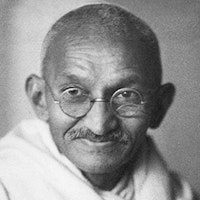
Mohandas K. Gandhi
Theme: Divine Love
About This Mohandas K. Gandhi Quotation [Citation]
Mohandas K. Gandhi’s quotation, “For I can see that in the midst of death life persists, in the midst of untruth truth persists, in the midst of darkness light persists. Hence I gather that God is Life, Truth, Light. S/He is Love. S/He is the Supreme Good,” reflects his deep belief in the enduring nature of divine qualities. Despite adversity, Gandhi sees a persistent benevolence that transcends the struggles and sufferings of life. This perspective, deeply rooted in his spiritual conviction, holds that the divine essence manifests through resilience and goodness, even in the darkest times. For Gandhi, these qualities are tangible forces that affirm God’s presence and benevolence.
In the broader context of this passage, Gandhi reflects on the ever-changing world and the constancy of a divine power that orchestrates this change. He perceives a “living power that is changeless, that holds all together,” identifying this as God. This power is the creator, sustainer, and redeemer of life. Gandhi’s insight into this eternal, benevolent force highlights his belief that despite apparent chaos and suffering, a steadfast divine presence ensures the persistence of life, truth, and light. His view encourages faith in a higher order that transcends life’s immediate adversities.
Gandhi’s identification of God with life, truth, light, and love offers a spiritual framework for overcoming adversity. He emphasizes that these divine attributes are ever-present, even in dire circumstances. This conviction provides a moral compass and strength for individuals facing challenges. By affirming that “God is Life, Truth, Light. S/He is Love. S/He is the Supreme Good,” Gandhi underscores the inherent goodness and benevolence of the divine, offering a message of hope and resilience. His words remind us that in our struggles, a persistent divine presence guides and sustains us, encouraging us to rise above adversity with faith and love.
Mahatma Gandhi Quotations Recognizing Divine Femininity
Mahatma Gandhi [Commentary by Eknath Easwaran]
Mohandas K. Gandhi (1869-1948; Mahatma means “great soul”) was born in British India and led his country to freedom through a thirty year struggle based completely on nonviolence. His formulation of satyagraha (“holding to truth”) as a systematic method for transforming conflict into unity among individuals, communities, and nations, is one of the inspired innovations of the twentieth century. His daily guidebook was the BHAGAVAD GITA, a core scripture of Hinduism, which he translated into his life. When he fell to an assassin’s bullet in January 1948, Albert Einstein was among the millions around the world who mourned, saying, “Generations to come, it may be, will scarce believe that such a one as this ever in flesh and blood walk upon the earth.” Gandhi’s own estimation of himself was characteristically different: “I have not the slightest doubt that any man or woman can achieve what I have, if he or she would make the same effort and cultivate the same hope and faith.”
“The Path” and “In the Midst of Darkness,” from articles Gandhi wrote for his weekly paper Young India in the 1920s, are included in many collections of Gandhi’s writings, including My Religion (Ahmedabad, India: Navajivan, 1955). Gandhi read “In the Midst of Darkness” for Columbia Gramophone Company while he was in England working for India’s independence in 1931―the first and the last time his voice was preserved in a studio recording.
―Eknath Easwaran [Blue Mountain Center of Meditation]. God Makes the Rivers to Flow: an Anthology of the World’s Sacred Poetry & Prose. Nilgiri Press, 2009, p. 203 [Mahatma Gandhi, My Religion (Ahmedabad, India: Navajivan, 1955)].
Resources
Related Quotes
Copyright © 2017 – 2025 LuminaryQuotes.com About Us