

Be grateful for your life, every detail of it, and your face will come to shine like a sun, and everyone who sees it will be made glad and peaceful.

Be grateful for your life, every detail of it, and your face will come to shine like a sun, and everyone who sees it will be made glad and peaceful.
Jalaluddin Mevlana Rumi

Glad and Peaceful
Topic: Gratitude
Be grateful for your life, every detail of it, and your face will come to shine like a sun, and everyone who sees it will be made glad and peaceful. Persist in gratitude, and you will slowly become one with the Sun of Love, and Love will shine through you its all-healing joy.
Jalāl al-Dīn Muḥammad Rūmī (born September 30, 1207, in Balkh, present-day Afghanistan – died December 17, 1273, in Konya, present-day Turkey) is revered as one of the world’s greatest poets, mystics, and spiritual teachers. Known in the West simply as Rumi, he was born into a family of scholars and mystics who fled westward during the Mongol invasions, eventually settling in Konya, then part of the Seljuk Empire. Under the guidance of his father, Bahāʾ al-Dīn Walad, Rumi was trained in Islamic theology, jurisprudence, and the contemplative disciplines of the Sufi path. His early years reflected the classical model of a scholar-saint—rooted in devotion, study, and service to his community.
Rumi’s life was transformed by his meeting with the wandering mystic Shams of Tabriz around 1244. Their profound spiritual companionship awakened in Rumi a passion that transcended formal learning and opened him to the depths of divine love. When Shams mysteriously disappeared, Rumi’s grief became the flame that illuminated his poetry and devotion. From this crucible emerged the Mathnawī, often called the “Persian Qur’an,” a six-volume masterpiece that weaves stories, parables, and reflections into a vision of love as the animating force of all creation. His shorter lyric poems, collected in the Divan-e Shams-e Tabrizi, sing of longing, union, loss, and the ecstatic dance between the soul and the Beloved.
Rumi’s teachings centered on the transforming power of divine love, the unity underlying all faiths, and the inward journey from self-centeredness to God-centeredness. He taught that every experience—joy and sorrow, presence and absence—serves as a mirror reflecting the divine mystery. After his passing, his followers established the Mevlevi Order, known for its sacred whirling as a form of remembrance (dhikr). Across eight centuries, Rumi’s voice has transcended language, culture, and creed, inviting seekers into the stillness of the heart where the human and divine meet in love."
Rumi's spiritual journey led him to develop a unique approach to Sufism that emphasized love, tolerance, and the pursuit of enlightenment. He created a fusion of traditional Islamic beliefs with mysticism, nurturing a school of thought that flourished in his followers. They established a sect known to the Western world as the 'Whirling Dervishes', a term derived from their mesmerizing practice of whirling as a form of physical meditation. The proper name for this branch is the Mevlevi order, dedicated to preserving and promoting Rumi's teachings.
In addition to being a mystic, Rumi was an accomplished scholar and theologian who left behind an impressive literary legacy. His best-known work, the Mathnawi or Masnavi, is a six-volume poetic epic that explores themes of love, divine mystery, and human connection to the spiritual world. Rumi's poetic style is marked by profound emotion and philosophical depth, weaving metaphors and allegory to create timeless pieces that continue to inspire readers today. Rumi's influence reaches far beyond his time, as his teachings on love, compassion, and unity continue to touch the hearts of millions, transcending barriers of religion, culture, and era.
The Discourses
Harvey, Andrew, and Hanut, Eryk (Phot.)―Rūmī Jalāl al-Dīn. Light upon Light: Inspirations from Rumi. North Atlantic Books, 1996. Step 3: Grateful Heart, Joyful Heart. [Jalāl al-Dīn Rūmī, The Discourses].
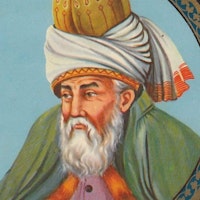
Jalaluddin Mevlana Rumi
Theme: Gratefulness
About This J. M. Rumi Quotation [Commentary]
Jalāl al-Dīn Muḥammad Rūmī invites us to “be grateful for your life, every detail of it,” recognizing that this attitude changes not only how we feel but how we appear to others. Gratitude, when sincerely practiced, reshapes the way we move through the world. Rumi writes that our face “will come to shine like a sun,” suggesting that the inner quality of thankfulness naturally expresses itself outwardly. The effect is not limited to the individual—“everyone who sees it will be made glad and peaceful.” Gratitude becomes a shared experience, uplifting both the one who offers it and those who encounter its expression.
Rumi deepens this vision by urging persistence: “Persist in gratitude, and you will slowly become one with the Sun of Love.” Here, gratitude is not a passing feeling but a steady orientation of the heart. Over time, this inner turning draws us into closeness with Love itself. The phrase “Sun of Love” suggests a divine source that warms, nourishes, and transforms. As Rumi writes, “Love will shine through you its all-healing joy,” making clear that this transformation is not only inward but also relational. Gratitude becomes a way for Love to enter the world through us.
Together, these lines offer a vision of gratitude as a spiritual path. Rumi does not separate everyday thankfulness from the deeper movement of union with Love. The instruction is both simple and far-reaching: honor every detail of your life, and something greater will begin to shine through. The joy that results is not held privately but becomes “all-healing,” shared in subtle and visible ways with others.
Rumi by Hazrat Inayat Khan
“The original words of Rumi are so deep, so perfect, so touching, that when one man repeats them hundreds and thousands of people are moved to tears. They cannot help penetrating the heart. This shows how much Rumi himself was moved to have been able to pour out such living words.”
—Hazrat Inayat Khan [The Heart of Sufism, Sufi Poetry, Rumi].
Additional Rumi Quotes and Poems
Resources
Related Quotes
Copyright © 2017 – 2025 LuminaryQuotes.com About Us