

The weak can never forgive. Forgiveness is the attribute of the strong.

The weak can never forgive. Forgiveness is the attribute of the strong.
Mohandas K. Gandhi

The Attribute of the Strong
Topic: Virtue, Morality, & Ethics
What is true of individuals is true of nations. One cannot forgive too much. The weak can never forgive. Forgiveness is the attribute of the strong.
Mohandas Karamchand Gandhi (born October 2, 1869, in Porbandar, in the Kathiawar region of present-day Gujarat – died January 30, 1948, in New Delhi) is revered worldwide as a moral and spiritual leader whose philosophy of nonviolent resistance profoundly shaped India’s struggle for independence. Raised in a devout Hindu household, Gandhi was formed by the religious pluralism of Gujarat, where Jain, Muslim, and Hindu traditions coexisted. After studying law at the Inner Temple in London, he traveled to South Africa in 1893 to work as a legal advocate. There, his encounters with racial discrimination and the injustices faced by Indian laborers awakened his conscience and inspired his lifelong commitment to satyagraha—steadfast adherence to truth through nonviolent action.
During his two decades in South Africa, Gandhi developed the principles that would define his life: nonviolence (ahimsa), civil disobedience, and the pursuit of self-rule grounded in moral discipline. Returning to India in 1915, he became a central figure in the movement for independence from British rule. Through peaceful protests, fasting, and broad programs of social reform, he worked to reshape not only political structures but the ethical character of society. He challenged caste discrimination, campaigned against untouchability, and encouraged simplicity, self-reliance, and the use of homespun cloth (khadi) as symbols of dignity and resistance. His mass movements—such as the 1930 Salt March—became landmarks in the global history of nonviolent struggle.
Gandhi’s life embodied a living synthesis of faith and action. Drawing wisdom from the Bhagavad Gita, the Sermon on the Mount, Jain ethics, and other religious traditions, he sought unity among faiths and dignity for all people. Though he was assassinated in 1948, his legacy endures as a moral compass for those seeking justice through peace. His life continues to testify that transformation begins within—and that courage, truth, and love remain among the most powerful forces for shaping a just society.
Gandhi, Mohandas K. (Mahatma). All Men Are Brothers: Autobiographical Reflections. Edited by Krishna Kripalani, Continuum, 1980. [Young India (2 April 1931), reprinted in Collected Works of Mahatma Gandhi Online Vol. 51.]
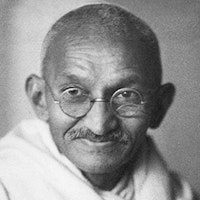
Mohandas K. Gandhi
Theme: Forgiving
About This Mohandas K. Gandhi Quotation [Commentary Part 1]
Mohandas K. Gandhi viewed forgiveness as a mark of strength, stating, “The weak can never forgive. Forgiveness is the attribute of the strong.” He believed that the act of forgiving is a potent demonstration of strength, rather than a passive quality, applicable to both individuals and nations. Gandhi’s philosophy, emphasizing nonviolence and self-mastery, advocates for forgiveness as an act requiring significant inner strength and resilience, rather than mere abandonment of resentment.
About This Mohandas K. Gandhi Quotation [Commentary Part 2]
In Gandhi’s perspective, forgiveness is not for the faint-hearted but for those with deep emotional and spiritual fortitude, capable of overcoming personal and historical grievances. He suggests that forgiveness should be boundless, highlighting its role not just in ending conflict but in fostering genuine reconciliation and understanding. This approach challenges both individuals and societies to see forgiveness as a reflection of their inner robustness and a step toward true reconciliation.
Gandhi’s discourse on forgiveness underscores its necessity in navigating the complexities of human relationships and historical conflicts, calling for a heart strong enough to withstand and heal these tensions. He frames forgiveness as an essential, active engagement with life’s challenges, signaling a resilient spirit and a commitment to peace and humanity. This vision positions forgiveness as crucial for both personal serenity and collective harmony.
Resources
Related Quotes
Copyright © 2017 – 2025 LuminaryQuotes.com About Us