

Nonviolence is a lifestyle that one has to adopt, which means allowing all the love, understanding, respect, compassion, acceptance, and appreciation to emerge and dominate one’s attitude.

Nonviolence is a lifestyle that one has to adopt, which means allowing all the love, understanding, respect, compassion, acceptance, and appreciation to emerge and dominate one’s attitude.
Mohandas K. Gandhi

Nonviolence Is a Lifestyle
Topic: Global Peace & Development
This philosophy is not like a jacket that you wear when necessary and discard when not. Nonviolence is a lifestyle that one has to adopt, which means allowing all the love, understanding, respect, compassion, acceptance, and appreciation to emerge and dominate one’s attitude. Then we will be able to build good relationships not only within the family but outside of the family. We will no longer be selfish and greedy but magnanimous and giving.
Mohandas Karamchand Gandhi (born October 2, 1869, in Porbandar, in the Kathiawar region of present-day Gujarat – died January 30, 1948, in New Delhi) is revered worldwide as a moral and spiritual leader whose philosophy of nonviolent resistance profoundly shaped India’s struggle for independence. Raised in a devout Hindu household, Gandhi was formed by the religious pluralism of Gujarat, where Jain, Muslim, and Hindu traditions coexisted. After studying law at the Inner Temple in London, he traveled to South Africa in 1893 to work as a legal advocate. There, his encounters with racial discrimination and the injustices faced by Indian laborers awakened his conscience and inspired his lifelong commitment to satyagraha—steadfast adherence to truth through nonviolent action.
During his two decades in South Africa, Gandhi developed the principles that would define his life: nonviolence (ahimsa), civil disobedience, and the pursuit of self-rule grounded in moral discipline. Returning to India in 1915, he became a central figure in the movement for independence from British rule. Through peaceful protests, fasting, and broad programs of social reform, he worked to reshape not only political structures but the ethical character of society. He challenged caste discrimination, campaigned against untouchability, and encouraged simplicity, self-reliance, and the use of homespun cloth (khadi) as symbols of dignity and resistance. His mass movements—such as the 1930 Salt March—became landmarks in the global history of nonviolent struggle.
Gandhi’s life embodied a living synthesis of faith and action. Drawing wisdom from the Bhagavad Gita, the Sermon on the Mount, Jain ethics, and other religious traditions, he sought unity among faiths and dignity for all people. Though he was assassinated in 1948, his legacy endures as a moral compass for those seeking justice through peace. His life continues to testify that transformation begins within—and that courage, truth, and love remain among the most powerful forces for shaping a just society.
Gandhi, Arun. “The Relevance of Gandhi Today.” Arun Gandhi - 5th Grandson of Mahatma Gandhi: Legacy of Love, 4 June 2013, arungandhi.net/the-relevance-of-gandhi-today/.
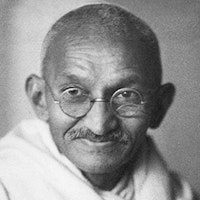
Mohandas K. Gandhi
Theme: Peace
About This Mohandas K. Gandhi Quotation [Commentary]
Mohandas K. Gandhi taught that nonviolence is “not like a jacket that you wear when necessary and discard when not,” but “a lifestyle that one has to adopt.” This way of living means “allowing all the love, understanding, respect, compassion, acceptance, and appreciation to emerge and dominate one’s attitude.” Gandhi’s words place the emphasis on active qualities of heart that shape how one relates to others. When such qualities guide thought and action, “we will be able to build good relationships not only within the family but outside of the family,” creating conditions for harmony and trust.
For Gandhi, letting love and compassion “dominate one’s attitude” required the discipline of self-purification. Without this inner work, he warned, the observance of nonviolence “must remain an empty dream.” Self-purification meant becoming “absolutely passion-free in thought, speech and action,” rising above “love and hatred, attachment and repulsion.” This path demanded humility, the willingness to “put oneself last among fellow creatures,” and the courage to face “the dormant passions lying hidden” within. Only by overcoming selfishness and greed could a person become “magnanimous and giving,” living in alignment with nonviolence.
Gandhi’s vision linked nonviolence to peace, not as the absence of conflict but as the outcome of transformed attitudes and relationships. When love, respect, and acceptance guide action, divisions give way to generosity and understanding. This, he believed, applies equally “within the family” and in the broader social and political sphere. For Gandhi, religion, politics, and daily life were inseparable, each shaped by the same commitment to truth and nonviolence. To live in this way is to let the qualities of the heart direct every field of life, building a peace that begins within and extends outward.
Mohandas K. Gandhi on Nonviolence
Mohandas K. Gandhi’s philosophy of nonviolence is like the iceberg—what is visible is only a fraction of what is hidden. Scholars have analyzed over and over the part that deals with political conflicts and independence of nations because they insist that nonviolence is simply a strategy of convenience.
Gandhi said: “This philosophy is not like a jacket that you wear when necessary and discard when not. Nonviolence is a lifestyle that one has to adopt which means allowing all the love, understanding, respect, compassion, acceptance, and appreciation to emerge and dominate one’s attitude. Then we will be able to build good relationships not only within the family but outside of the family. We will no longer be selfish and greedy but magnanimous and giving.”
It is no longer a secret that official India had abandoned Gandhi’s philosophy [known as Satyagraha] upon gaining independence. However, there are many at the grassroots level, young and old, who are still inspired by his philosophy and have put it into action to bring about a qualitative change in Indian society. Many have started projects to bring solace to the poor of whom there are more than 500 million in India.
—Gandhi, Arun. “The Relevance of Gandhi Today.” Arun Gandhi – 5th Grandson of Mahatma Gandhi: Legacy of Love, 4 June 2013, arungandhi.net/the-relevance-of-gandhi-today/.
[For more of Arun Gandhi’s Commentary About His Grandfather’s Philosophy see the link in Resources.]
Additional Arun Gandhi Quotes
Additional Mohandas K. Gandhi Quotes
Resources
Related Quotes
Copyright © 2017 – 2025 LuminaryQuotes.com About Us