

Great forgiveness is possible when you have understood the other person’s situation one hundred percent.

Great forgiveness is possible when you have understood the other person’s situation one hundred percent.
Sun Myung Moon

Great Forgiveness Is Possible
Topic: Virtue, Morality, & Ethics
Great forgiveness is possible when you have understood the other person’s situation one hundred percent. Because God knows our situations, S/He forgives us.
Sun Myung Moon (born January 6, 1920, in Jeongju, in what is now North Korea – died September 3, 2012, in Gapyeong, South Korea) was a Korean religious leader, entrepreneur, and founder of the Unification movement. Raised in a rural Confucian-Christian household during the Japanese occupation of Korea, Moon’s early life was shaped by hardship, devotion, and a strong sense of spiritual calling. As a teenager, he experienced a profound vision in which he believed Jesus commissioned him to complete the work of restoring humanity to unity with God. This revelation became the foundation of his lifelong ministry, devoted to the ideal of universal peace and the healing of the relationship between the divine and human families.
In 1954, after enduring persecution and periods of imprisonment under both Japanese and communist authorities, Moon founded the Holy Spirit Association for the Unification of World Christianity in Seoul. His teachings—later presented systematically in the Exposition of the Divine Principle—offered a reinterpretation of Christian theology emphasizing God’s parental love, human responsibility, and the sanctity of marriage and family. Central to his vision was the belief that love is the creative force of the universe and that humanity’s purpose is to build a world reflecting the oneness of God’s heart. Through international missions, interfaith dialogue, and mass wedding ceremonies symbolizing global reconciliation, Moon sought to transcend divisions of race, religion, and nationality.
Beyond his religious work, Moon established numerous organizations in education, media, culture, and humanitarian service, aiming to foster dialogue, moral renewal, and peace. He and his wife, Hak Ja Han Moon, were regarded by followers as the “True Parents,” embodying the ideal of restored unity between men and women, heaven and earth. While his movement inspired both devoted commitment and significant controversy, Moon’s influence on global religion, culture, and peace initiatives remains substantial. His life reflected an unwavering pursuit of the vision of one human family under God—a vision he advanced with conviction, discipline, and enduring faith in the transformative power of divine love.
Reverend Moon's teachings went beyond the realm of the spiritual to touch on the universal human themes of love and family. He emphasized the importance of nurturing strong, loving families as the cornerstone for a harmonious and peaceful world. To this end, he conducted mass wedding ceremonies known as the 'Blessing', symbolizing the unity of all people under God, regardless of their cultural or religious backgrounds. Moon also stressed the value of community service and encouraged his followers to actively contribute to their local communities.
Sun Myung Moon's partner in both life and work was his wife, Hak Ja Han Moon. As co-leader of the Unification Church, she is a pivotal figure in spreading their shared vision of a world unified by love and peace. Affectionately known as 'True Mother', she embodies the ideal of nurturing and unconditional love in their teachings. After Reverend Moon's passing in 2012, Hak Ja Han Moon assumed sole leadership of the Unification Church and changed the name to Heavenly Parent's Holy Community. In her leadership role, she has tirelessly carried forward their mission, upholding the church's emphasis on peace, interfaith dialogue, and strong, loving families. Under her guidance, the church has continued to flourish, spreading its message of unity and love to people around the globe.
Moon, Sun Myung. Wilson, Andrew, editor. World Scripture II. Universal Peace Federation, 2011, p. 683 [Sun Myung Moon 2:220, May 26, 1957].
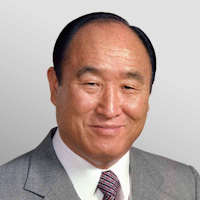
Sun Myung Moon
Theme: Forgiving
About This Sun Myung Moon Quotation [Commentary]
Sun Myung Moon teaches that “great forgiveness is possible when you have understood the other person’s situation one hundred percent.” This is not partial empathy or surface-level sympathy. Forgiveness, in this light, grows from full understanding—from seeing the other clearly, without distortion or defensiveness. When one comprehends the full extent of another’s situation, including their intentions, pressures, and limits, the possibility of forgiveness opens. Without that depth of understanding, forgiveness remains incomplete or strained.
He continues, “Because God knows our situations, S/He forgives us.” The divine does not forgive from afar, but from knowing everything about us—our fears, confusion, failures, and efforts. Sun Myung Moon’s linking of divine and human forgiveness shows that understanding is not only essential but sacred. Just as God’s forgiveness comes from perfect knowing, human beings are called to forgive by coming as close as possible to that level of seeing. The more fully we understand someone’s inner and outer world, the more natural forgiveness becomes.
In saying that “great forgiveness is possible” only when we understand “one hundred percent,” Sun Myung Moon emphasizes the necessary depth for genuine reconciliation. Partial understanding may create tolerance, but not healing. Forgiveness becomes possible when we no longer reduce someone to their actions but see them within the full context of their life. This perspective invites a way of relating that mirrors divine mercy—based not on what someone deserves, but on a shared human reality understood with compassion.
Andrew Wilson’s Commentary About Forgiveness
A large-hearted attitude of forgiveness to those who have done us wrong is advocated in all the scriptures. Forgiveness is at the heart of Jesus’ message; indeed according to The Lord’s Prayer it is incumbent upon the Christian to forgive. God is most forgiving. It states in the Qur’an that people who seek to draw near to God should likewise be full of forgiveness. Forgiving is natural to a parent; therefore if we can take a parental heart towards others, akin to the heart of God our Father, we can forgive them. While it may be difficult to forgive people who do us grave injustice or injury, it is far preferable to holding a grudge, which would only fester and poison the spirit.
Yet how can we forgive? Forgiveness is not a natural thing. It will not do to simply forget a wrong or sweep it under the rug. Such easy or ritualistic forgiveness is phony and can mask deeper feelings of lasting resentment. As theologian Paul Tillich wrote, “Forgiving presupposes remembering. And it creates a forgetting not in the natural way we forget yesterday’s weather, but in the way of the great in spite of that says: I forget although I remember.” [Reverend] Moon teaches that we need to find a positive reason to forgive, a reason to make a new beginning in relating to that person in spite of the painful memory of previous wrongs. Thus he explores the reasons why God forgives us, and searches for that point of weakness and pathos in the wrongdoer that can evoke the heart of compassion.
—Andrew Wilson, editor. World Scripture II. Universal Peace Federation, 2011, pp. 682-683.
Additional passages that express God’s forgiving nature
Related Quotes
Copyright © 2017 – 2025 LuminaryQuotes.com About Us